Fendi Authentication Guide: Hologram Stickers, Serial Numbers & Selleria Stitching
Fendi authentication, Fendi hologram sticker checks are essential when buying a Peekaboo, Baguette, By the Way, or vintage Zucca piece on the resale market. Fendi’s clean Italian craftsmanship, FF canvas, and soft leather finishes are widely copied, and modern counterfeits often include fake serial numbers, imitation holograms, and convincing packaging. The key is not to rely on one detail alone. Authenticating Fendi means reading the bag as a whole: hologram, serial format, stitching, leather, hardware, lining, and seller history should all make sense together.
Why Fendi Authentication Requires Multiple Checks
Fendi bags can be deceptively difficult to authenticate because the brand has produced many variations across decades. A 1990s Baguette, a 2010s Selleria Peekaboo, and a current By the Way bag will not share every detail. That is why a missing hologram may be normal on a vintage bag but suspicious on a modern one.
The goal is to confirm whether the bag’s features match its era, style, and production details. A genuine Fendi should feel refined, consistent, and intentional. A fake often reveals itself through one or two mismatched clues.
The Fendi Hologram Sticker and Serial Number System
One of the most important modern checks in Fendi authentication, Fendi hologram sticker review is the interior sticker system. Fendi introduced holographic stickers and serial numbers around 2004, so bags made after that period should generally include one. Bags produced before 2004, especially vintage Baguettes from the late 1990s and early 2000s, may not have a hologram at all.
On an authentic post-2004 Fendi bag, the round holographic sticker is usually placed inside the bag on a leather tab, fabric label, or interior wall. It should shift between silver and gold tones when tilted under light. The word “FENDI” and a serial number should appear clearly, not as a flat printed graphic.
When checking the hologram, look for:
- A genuine reflective effect that changes with movement
- A thin sticker that sits flush against the surface
- Clean edges with no peeling, bubbling, or lifting
- A serial number that corresponds logically with the bag style
- No blurry printing, cloudy film, or cheap foil appearance
Counterfeiters often use flat silver stickers that look shiny but do not truly refract. Others may add a hologram that peels away easily or appears too thick. Authentic stickers are notoriously difficult to remove cleanly.
How to Read Fendi Serial Numbers
Fendi serial numbers often follow a structured format that may include a model code, a sequence of digits, and additional production identifiers. A common format may look similar to: two or three model characters, followed by several numbers and grouped code sections.
For example, model codes such as “8BR” or “8BN” may appear on certain Fendi styles, though formats can vary by era and line. The important point is that the serial number should match the model, period, and interior stamping style.
Check the serial number by asking:
- Does the code format look consistent with the bag’s production era?
- Does the model code make sense for the style?
- Is the number also heat-stamped or embossed elsewhere inside?
- Do the sticker and embossed number match or correspond logically?
- Is the font clean, evenly spaced, and properly aligned?
A mismatch between the hologram sticker and the embossed interior serial number is a major red flag. It can indicate that the sticker was copied from another bag or added later to make a counterfeit seem more convincing.
Expert Tip #1: Never authenticate a Fendi bag from the hologram alone. Counterfeiters can clone stickers, but they often fail to match the serial number, model code, leather quality, and construction details at the same time.
Selleria Stitching and Leather Quality
Fendi’s Selleria line is one of the strongest craftsmanship indicators because the stitching is difficult to fake well. Selleria bags are known for visible saddle stitching, often done in a waxed thread that may be tonal or slightly lighter than the leather.
Authentic Selleria stitching should look consistent but not perfectly machine-flat. Each stitch is hand-pulled, creating a subtle angled pattern. If a bag is marketed as Selleria but has straight machine stitching with no diagonal saddle-stitch effect, that is a serious warning sign.
Look closely at the stitching:
- Selleria stitches should be slightly angled, not perfectly vertical
- Thread should look substantial, waxed, and cleanly finished
- Spacing should be even without looking overly mechanical
- Loose threads, skipped stitches, or messy knots are suspicious
- Stitching should follow curves smoothly without bunching
Many Selleria bags also include a separate metal plaque engraved with a unique edition number. This plaque is usually located inside the bag and should be cleanly engraved, securely attached, and appropriate for the style.
Leather Grain, Edge Paint, and Feel
Authentic Fendi leather has a refined, luxurious feel. On Selleria, Peekaboo, and By the Way styles, the leather is often full-grain calfskin with subtle natural pebbling. It should not look plasticky, overly shiny, or artificially stamped with a perfectly uniform grain.
Run your eye along the edges of the bag. Authentic Fendi edge paint is applied carefully in multiple coats and burnished smooth. Chunky, uneven, sticky, or chipping edge paint on a supposedly new bag is a telltale counterfeit sign.
Common leather red flags include:
- Strong chemical odor
- Plastic-like shine
- Overly uniform machine-pressed grain
- Thin, stiff, or papery leather
- Messy edge coating or cracking on light use
FF Zucca and Zucchino Canvas Checks
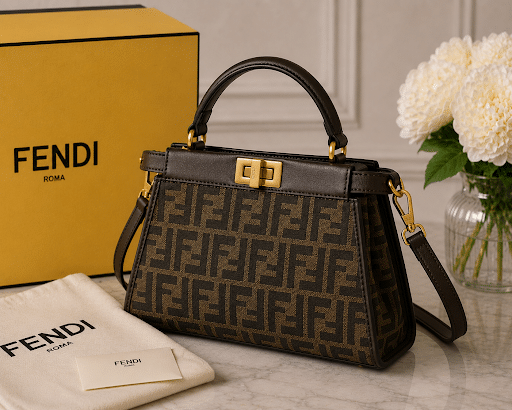
Fendi’s FF canvas is iconic, but it is also one of the most copied details. The large FF pattern is known as Zucca, while the smaller version is often called Zucchino. On authentic bags, the pattern should align cleanly across seams and panels whenever the construction allows.
Study the interlocking Fs carefully. The reversed F should be a true mirror image, with balanced bars and consistent spacing. On fakes, one F may look slightly distorted, the middle bar may sit too high or low, or the pattern may break awkwardly across seams.
Check the canvas for:
- Clean, sharp FF shapes
- Symmetrical mirrored Fs
- Consistent color and weave
- Proper alignment across seams
- No upside-down or randomly placed pattern sections
Hardware, Engravings, and Zippers
Fendi hardware should feel substantial without being clunky. Peekaboo and Baguette locks should operate smoothly with a precise click. A loose, wobbly, stiff, or noisy turn-lock can point to poor counterfeit casting.
Engravings should be crisp, centered, and consistent. The “FENDI” lettering should not look shallow, fuzzy, or uneven. Hardware color should also match across the bag, including rings, clasps, feet, zipper pulls, and logo plates.
Zippers vary by line, but Fendi commonly uses high-quality zippers such as Lampo on many leather bags. Some non-leather or specific production lines may differ, but a generic zipper on a luxury leather Peekaboo should be questioned.
Expert Tip #2: Always compare hardware function, not just appearance. Many fakes photograph well, but the lock, zipper, clasp, or chain will feel loose, tinny, or poorly balanced in person.
Interior Lining and Era Accuracy
The interior should match the style and production period. A Peekaboo may feature suede or grosgrain, while a Baguette Re-Edition may use satin or leather depending on the model. By the Way bags may include canvas or jacquard-style interiors.
When reviewing the lining, check whether it makes sense for the exact bag. A lining that feels cheap, thin, noisy, or mismatched to the model can be a warning sign. The interior label, stitching, zipper, and serial placement should all look intentional.
What to Do If You Are Unsure
The safest approach to Fendi authentication, Fendi hologram sticker checks is to avoid making a decision from one feature. A real hologram does not automatically mean the bag is authentic, and a missing hologram may be normal on a pre-2004 vintage piece.
Before purchasing, ask the seller for clear photos of:
- The front, back, base, and sides of the bag
- The hologram sticker and serial number
- Any embossed interior codes
- Close-ups of stitching and edge paint
- Hardware engravings and zipper pulls
- The interior lining and brand plaque
If the seller refuses detailed photos, avoids questions, or pressures you to buy quickly, walk away. For high-value Fendi bags, especially Peekaboo, Baguette, and Selleria styles, a professional authentication service is worth the small extra cost.
Summary
Authentic Fendi bags combine refined materials, precise hardware, logical serial details, and craftsmanship that feels consistent from the inside out. The hologram sticker is important, but it is only one part of the full authentication picture. Check the serial number, Selleria stitching, FF canvas alignment, leather quality, hardware, lining, and seller behavior before making a purchase.
Ready to shop with more confidence? Explore our curated collection of authenticated luxury handbags and find your next Fendi favorite here: Shop our Fendi collection.