Celine Authentication Guide: Date Codes, Leather Quality & Subtle Logos
Celine authentication, Celine date code checks are especially important because Celine is one of the most understated luxury houses in the resale market. Unlike brands that rely on loud monograms or oversized hardware, Celine bags are usually authenticated through quiet details: production stamps, leather quality, stitching, logo placement, hardware feel, and packaging consistency.
This is true across both major modern eras of the brand: the Phoebe Philo era from 2008 to 2018, known for the Luggage, Trapeze, Belt Bag, Classic Box, and Cabas, and the Hedi Slimane Celine Paris era from 2018 onward, known for the Triomphe, 16, Besace, and revived archival codes. Because counterfeiters often get the silhouette right, authenticating Celine requires a close, layered inspection.
Why Celine Bags Are Difficult to Authenticate
Celine is famously logo-light. That minimalist design language is part of the appeal, but it also makes authentication more nuanced. A fake Celine bag may look convincing from across the room because there are fewer obvious logos to compare. The real test is whether the materials, construction, stamping, and hardware all tell the same story.
A strong Celine authentication, Celine date code review should never rely on one detail alone. A production stamp can be copied. A dust bag can be switched. A receipt can be forged. The safest approach is to examine the bag as a complete object and ask whether every detail aligns with the claimed style, year, and era.
1. Check the Celine Date Code and Production Stamp
Celine uses an alphanumeric production code, often heat-stamped on a small leather tab inside the bag. Depending on the style, the tab may be located inside a side seam pocket, beneath an interior flap, or tucked into a discreet interior area. It is not always immediately visible, so take your time inspecting the lining and interior seams.
The format is commonly a letter followed by digits or grouped letters and numbers, such as a code resembling F-AB-1145. Celine has not officially published a universal date code decoder, so treat any seller’s exact “decoded” explanation with caution. Some collectors associate certain letters with manufacturing locations, such as France or Italy, and some digits may suggest production timing, but the code should be used as a cross-check rather than absolute proof.
- Look for crisp stamping: Authentic stamps are clean, evenly spaced, and lightly debossed into the leather.
- Avoid smudged codes: Blurry ink, uneven depth, or a stamp that looks printed on top of the leather can be a red flag.
- Check placement: The code should appear in a logical interior location for that specific model.
- Compare with the era: The stamp style should match whether the bag is Phoebe-era or Hedi-era.
Brand spelling also matters. Phoebe-era bags commonly use “CELINE PARIS” without the accent. Around the 2018 transition, branding changed as Hedi Slimane reintroduced certain archival references and updated the visual identity. A logo that does not match the claimed year should prompt a deeper review.
Expert Tip #1: Do not reject a Celine bag only because you cannot “decode” the production stamp online. Celine date codes are less publicly standardized than Louis Vuitton date codes, so authentication should focus on whether the stamp quality, placement, font, and bag construction are consistent.
2. Examine Leather Quality and Structure
Leather is one of the most important parts of Celine authentication. The house is known for refined calfskin, box calf, drummed leather, smooth lambskin, and structured silhouettes. Counterfeit bags often fail because the leather is too thin, too plasticky, too glossy, or too limp for the model being copied.
The Luggage tote, introduced in 2010, is a perfect example. Authentic Luggage bags may soften with use, but the “wings” should still have structure. On a new-condition or lightly used bag, wings that collapse immediately can indicate thin imitation leather or weak construction.
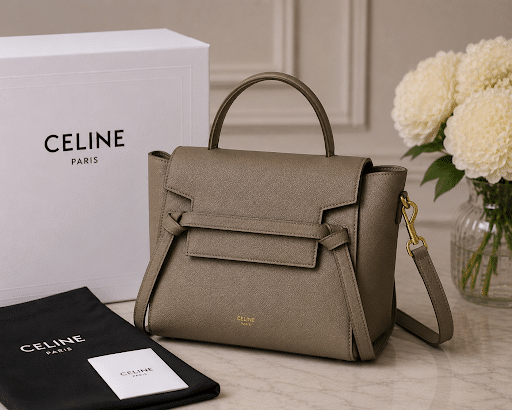
The Belt Bag, introduced in 2014, usually features grained calfskin and the signature knotted belt closure. The knot should look intentional, balanced, and tightly formed. Edge paint along the strap should be neat, thin, and smooth, not globby or rubbery.
The Classic Box, reintroduced during the Phoebe Philo era, is another model where leather quality is critical. Authentic box calfskin has a polished, almost glassy finish, but it should not look like a cheap synthetic coating. Counterfeits may use overly shiny leather that scratches poorly, creases strangely, or feels stiff in the wrong way.
- Stitching: Celine stitching is usually even, tight, and consistent, often around 7–9 stitches per inch.
- Thread color: Thread should match the leather or sit only slightly off-tone by design.
- Edge paint: Authentic edge paint is applied in thin, controlled layers.
- Shape retention: Structured bags should hold their intended silhouette.
Thick, plasticky edge paint, cracked coating at fold points, looping stitches, or inconsistent stitch length are all warning signs. On Celine, quiet precision is the point.
3. Inspect Logos, Hardware, and Closures
Celine logos are subtle, so small differences matter. On Phoebe-era Belt Bags and Trapeze bags, the front “CELINE PARIS” embossing is usually shallow, clean, and sharply spaced. The letters tend to be tall and narrow rather than thick or bubbly. Fake embossing often looks too deep, too fat, or unevenly pressed.
Hardware should also feel refined. Phoebe-era bags often used antique gold, matte palladium, or understated hardware finishes. Hedi-era designs lean more visibly into shiny gold, aged brass, and the Triomphe motif depending on the collection. A bright chrome finish on a Phoebe-era Luggage, for example, would be suspicious.
The Triomphe clasp, revived under Hedi Slimane and inspired by Celine’s 1970s archive, should be cleanly cast with sharp interior detail. On the Triomphe Bag, 16, and Besace, the closure should engage with a precise mechanical click. A loose, mushy, or rattling clasp can indicate a counterfeit.
- Zippers: Phoebe-era bags often use Lampo zippers, while Hedi-era bags may include Lampo or Riri depending on the model.
- Pull engraving: Many zipper pulls are engraved with “CELINE,” though some older bags may have unmarked Lampo pulls.
- Feet: Luggage and Cabas feet should be flat metal studs, not cheap domed rivets.
- Closure feel: Clasps and turn locks should feel secure, aligned, and smooth.
Expert Tip #2: Hardware should match the model’s design language. Celine rarely uses flashy hardware without purpose. If the finish looks too bright, too lightweight, or inconsistent with the bag’s era, investigate further.
4. Review Dust Bag, Care Card, and Packaging
Packaging can support authentication, but it should never be the only deciding factor. Dust bags, cards, and boxes are easy to replace or counterfeit. Still, they can help confirm whether a seller’s story makes sense.
Phoebe-era dust bags are often cream or off-white cotton with “CELINE PARIS” centered in dark text. Hedi-era dust bags transitioned into updated colors and typography, including darker beige tones and, on some collections, Triomphe-related branding. Authentic dust bags usually use a flat cotton drawstring. Shiny ribbon, nylon cord, or flimsy synthetic fabric is not typical of genuine Celine packaging.
Care cards from the Phoebe era are generally minimal: cream cardstock, clean printing, and restrained typography. Hedi-era packaging may include updated fonts and Triomphe references on certain collections. Boxes should feel matte and refined. Glossy boxes are not typical of Celine’s luxury presentation.
- Check typography: Fonts should match the era and collection.
- Feel the fabric: Dust bags should feel like quality cotton, not slippery synthetic material.
- Question perfect packaging: A vintage bag with suspiciously new packaging may have mixed accessories.
- Look for consistency: Bag, code, dust bag, card, and box should all align with the claimed year.
What to Do If You Are Unsure
Celine is one of the harder luxury houses to authenticate because the brand publishes very little public information about date code decoding, and many Phoebe-era pieces are now highly desirable on the resale market. As demand rises, counterfeiters pay closer attention to the details collectors care about most.
If the Celine date code, leather quality, logo, and packaging do not tell a coherent story, do not rely on the seller’s explanation alone. Ask for clear photos of the production stamp, interior tab, logo embossing, zipper pulls, stitching, underside of hardware, feet, corners, glazing, dust bag, and care cards. A reputable seller should be willing to provide them.
Summary: How to Authenticate a Celine Bag
A successful Celine authentication, Celine date code inspection depends on craftsmanship, not just logos. Start with the production stamp, then compare the leather, stitching, edge paint, hardware, logo embossing, and packaging against the bag’s claimed style and era. Real Celine bags feel precise, structured, and understated. Counterfeits often reveal themselves through one detail that feels too loud, too cheap, or out of place.
If you want a Celine bag without the guesswork, shop carefully from trusted sources and choose sellers who understand authentication. Browse our curated collection of authenticated designer handbags here: Shop our Celine collection.