Prada Authentication Guide: Factory Codes, Lining & Brand Plaques
Luxury resale buyers are paying closer attention than ever to Prada authentication, especially as counterfeit Prada bags become increasingly difficult to spot. From nylon Re-Edition shoulder bags to structured Saffiano Galleria totes, modern replicas now mimic silhouettes, hardware weight, and even interior details with alarming precision. But while superfakes may fool casual shoppers, they often fail under close inspection of the Prada factory code, logo engraving, lining construction, and hardware quality.
Unlike logo-heavy brands, Prada relies on understated luxury. That means authenticators focus less on monograms and more on craftsmanship, precision, and consistency. This guide walks through the four major authentication checkpoints that help separate a genuine Prada from a convincing counterfeit.
The Triangle Plaque and Logo Engraving
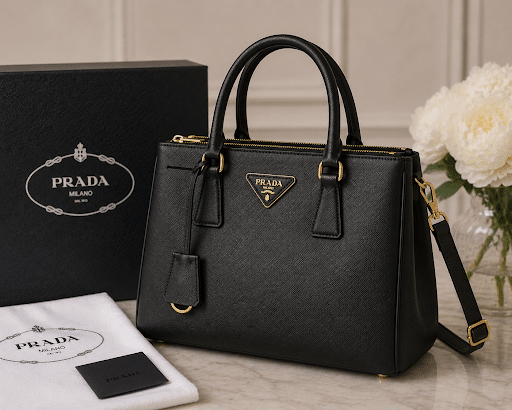
The iconic Prada triangle plaque is one of the most important authentication details. On authentic bags, the enameled triangle sits perfectly flush against the leather or nylon surface. Counterfeit versions frequently show raised edges, uneven glue residue, or poorly aligned attachment points.
Pay close attention to the typography of the logo itself.
- The “R” in PRADA has a sharp, straight angled leg.
- The “A” features a flat top apex rather than a pointed peak.
- Letter spacing is tight, balanced, and symmetrical.
- MILANO appears centered beneath PRADA on most styles.
- DAL 1913 is included above the logo on select Galleria and Saffiano bags.
Fake plaques often use softer fonts with rounded edges or inconsistent spacing. The differences can seem minor, but authentic Prada typography is remarkably precise.
Metal logo plaques on styles like the Re-Edition 2000, Re-Edition 2005, and Cleo should feature deeply engraved lettering with crisp edges. If the letters appear shallow, soft, or stamped into the metal unevenly, the bag may be counterfeit.
Hardware finish also matters during Prada authentication. Prada changes finishes depending on the collection era:
- 2007–2015 Galleria bags: often antique brass or muted gold-tone hardware
- Post-2018 Galleria styles: brighter polished gold hardware
- 2019+ nylon Re-Editions: commonly silver-tone hardware
Mismatched hardware finishes relative to the production period can indicate a fake or heavily altered bag.
Interior Lining, Logo Jacquard, and Factory Code
Interior construction is one of the strongest indicators of authenticity because counterfeiters often focus heavily on the exterior while overlooking internal precision.
Authentic Prada linings vary by collection:
- Saffiano Galleria bags: smooth tonal or black nylon-blend interiors
- Re-Edition nylon bags: matching Re-Nylon interiors
- Cahier and Sidonie styles: may feature suede interiors
On many nylon styles, Prada uses a jacquard textile lining featuring repeating “PRADA” logos in a geometric pattern. The alignment should appear uniform and centered, even near seams. Counterfeit bags frequently display warped patterns, inconsistent spacing, or off-center text.
One of the most discussed details in Prada authentication is the interior tag system.
Most authentic Prada bags include:
- A white leather interior tag stitched into the seam
- “PRADA” on the top line
- “MILANO” or “MADE IN ITALY” underneath
- Clean, parallel stitching with roughly 7–9 stitches per inch
Behind or beneath this leather tag, you’ll typically find a smaller cloth production tag containing the Prada factory code or lot information. These codes may begin with letters like R or M, or use numerical sequences tied to production facilities and manufacturing periods.
Importantly, Prada does not publicly release a database for decoding these tags. During authentication, experts care more about:
- The existence of the factory tag
- Correct placement
- Clean stitching
- Accurate font and tag material
A major red flag is a leather serial number stamp directly embossed into the interior leather tag. Authentic Prada bags do not use stamped leather serial numbers. Production information belongs exclusively on the cloth lot tag.
Expert Tip #1: Don’t Over-Rely on QR Codes
Some newer Prada bags include RFID or QR technology, but counterfeiters now replicate these with surprising accuracy. A working QR code alone does not confirm authenticity. Always combine digital verification with physical inspection of the plaque, stitching, lining, and factory tag.
Hardware, Zippers, and Construction Quality
Prada hardware is engineered with exceptional consistency. Even subtle flaws in zipper quality or metal finishing can reveal a counterfeit.
Authentic Prada bags from approximately 2005–2015 commonly use:
- Lampo zippers
- Riri zippers
The zipper pull underside is often engraved with the manufacturer’s branding. Starting around 2016, Prada increasingly incorporated custom-branded pulls and IPI hardware.
Counterfeit bags frequently use generic YKK zippers, especially on bags pretending to be vintage Prada. That’s an immediate warning sign.
Authentic zipper teeth should glide smoothly without resistance or uneven spacing. Cheap replicas often snag, grind, or feel lightweight.
On Galleria and Double Bag styles, the bottom feet provide another important authentication clue. Genuine Prada feet are screwed in from the inside using visible flat-head screws. Fake versions are often glued, riveted, or unevenly attached.
Leather edge paint is another overlooked detail. Authentic Prada edge coating appears smooth, even, and thinly layered. Counterfeits often show thick paint, bubbling, or rough application.
Dust Bags, Cards, and Packaging
Packaging alone cannot authenticate a Prada bag, but it can support other findings.
Modern Prada dust bags are usually:
- Black with white “PRADA MILANO” text
- Made from soft cotton material
- Finished with metal-capped drawstring ends on newer models
Older bags and certain regional releases may include beige or tan dust bags instead.
Authentic care cards and authenticity materials are typically black with silver foil printing. Most Prada bags also include a “Certificate of Authenticity” card or booklet containing a unique number loosely connected to the factory production information.
However, counterfeiters now copy cards extremely well, so documentation should never outweigh physical construction analysis.
Expert Tip #2: Compare Era-Specific Details
One of the best ways to identify superfakes is to compare the bag against verified authentic examples from the exact same production year. Prada frequently changes hardware finishes, lining materials, zipper suppliers, and logo details across seasons. Many counterfeit bags combine details from multiple eras that would never appear together on an authentic piece.
What to Do If You’re Unsure
Even experienced resellers sometimes struggle with modern Prada replicas. If the plaque feels questionable, the factory tag appears inconsistent, or the hardware finish doesn’t align with the production era, avoid relying on a single authentication “tell.”
Instead, evaluate the bag holistically:
- Logo typography
- Factory code placement
- Lining consistency
- Hardware quality
- Zipper branding
- Construction precision
When uncertainty remains, submit detailed photos to a professional authentication service such as Entrupy, Real Authentication, or a luxury consignment expert familiar with Prada production variations.
Final Thoughts on Prada Authentication
Authenticating Prada requires careful attention to craftsmanship rather than obvious branding. The triangle plaque, logo typography, zipper quality, and especially the Prada factory code system remain some of the strongest indicators of authenticity.
As counterfeit quality continues to improve, buyers and resellers should approach every Prada purchase with a layered authentication process instead of relying on a single detail.
Looking for authenticated luxury handbags? Browse our curated collection of verified designer pieces and shop with confidence at Barbee Dreamhouse Luxury Resale.